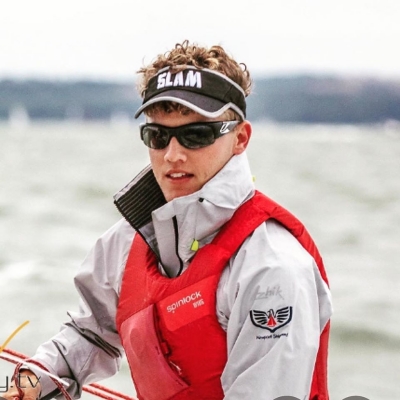
For most spectators, Olympic sailing begins when the broadcast starts. For the athletes, Los Angeles 2028 began years earlier. The road to a home Games is a sequence of training blocks, international regattas, equipment decisions, selection events and moments when a team has to decide whether its progress is fast enough.
The Nacra 17, campaigned by both USA 50 Racing and ISR36, is a two-person mixed event. One woman and one man race together on a foiling catamaran. Their jobs are different but inseparable. They balance the boat, trim the sails, control the foils, read the wind and make tactical decisions while moving at speeds that can make the course feel very small.
What should a newcomer watch?
Start with the beginning of each race. Teams approach an invisible starting line while trying to arrive at full speed at exactly the right second. A boat that crosses early must turn back. A boat that arrives late may spend the entire race trying to recover.
Then watch the distance between boats rather than trying to memorize every rule. A team that finds stronger wind can gain rapidly. A slow turn can lose several places. At course marks, boats converge and decisions happen quickly. The best teams make difficult maneuvers look calm because both athletes already know what the other is about to do.
How teams reach the Games
Olympic participation requires both a place for the country and selection by the country’s governing system. Those are related but separate challenges. A team may need to help qualify its nation, then prove that it should be the team chosen to represent that nation. The exact pathway varies, but international results, designated trials and sustained performance all matter.
That makes every major regatta part competition and part information. Coaches study speed in different conditions. Athletes learn whether a problem comes from technique, equipment or decision-making. Results matter, but so does the rate of improvement.
Los Angeles adds another dimension. The 2028 sailing venue gives American athletes the rare chance to train toward an Olympic Games in familiar waters. It also gives local supporters years—not days—to learn the teams, understand the sport and become part of the journey.
Follow USA 50 Racing and ISR36 as their LA 2028 campaigns develop.